Tarjimly Spark AI
AI Interpreter for everyday conversations
2025
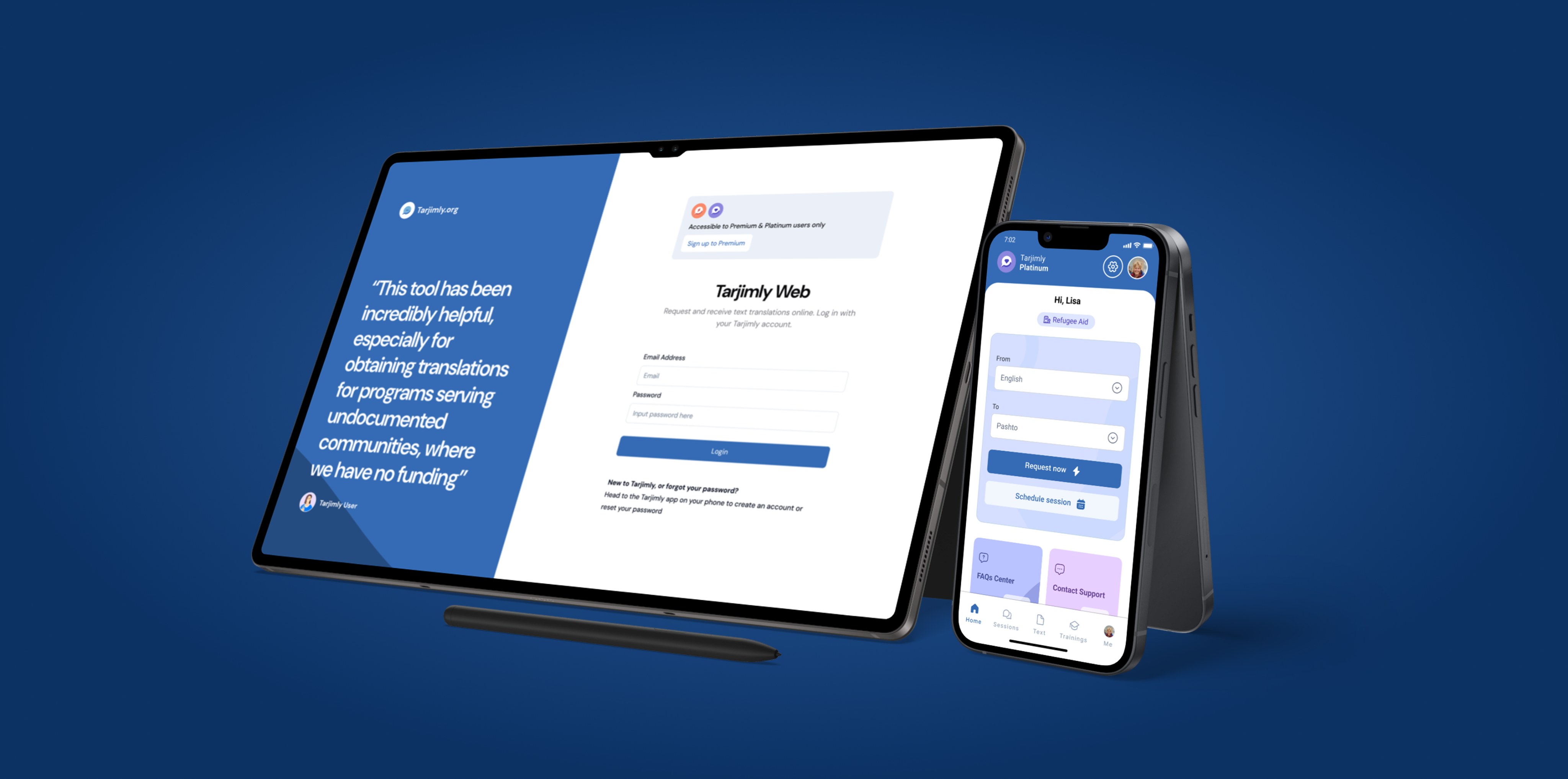
Tarjimly is the "Uber for Translation," connecting 60,000+ volunteers with refugees and aid workers. But unlike calling an Uber, our users are often in crisis—medical emergencies, border crossings, or legal disputes.
Role:
Senior Product Designer
Timeline:
4 Weeks (Concept to Beta)
Outcome:
Reduced average wait time from 90s to <3s
The Friction
While our volunteer network is vast, human matching takes time (average: 60–90 seconds). In high-stress environments, a minute of silence feels like an hour. We noticed a 25% abandonment rate on "short-form" requests. Users were leaving before help arrived.
The Design Challenge
How might we provide instant support for low-stakes queries without losing the human empathy that defines our brand?
The Insight
We went deep into the chat logs and conducted user interviews in Greece and Turkey. We discovered that for simple tasks, like reading a medicine label or asking for directions. Users didn't necessarily want a conversation, they wanted agency.
They didn't just want to hand their phone to a doctor, they wanted to know how to say the words themselves.
The Hypothesis
If we deploy an AI "First Responder" to handle simple translation and pronunciation immediately, we can reduce anxiety and save human volunteers for the complex, high-empathy calls.
The Solution: Spark AI
We designed Spark AI, an intelligent triage layer that lives inside the chat. It isn’t a barrier to reaching a human; it’s a bridge.
Feature A: The "Voice" of the Text (Transliteration)
Standard translation apps give you the script (e.g., Arabic). But if you can't read Arabic script, the text is useless for speaking.
- The Design Fix: Spark AI provides the Phonetic Transliteration by default.
- The Result: A user sees “Wayn al-mahata?" alongside the Arabic script. This empowers them to speak the language, shifting the power dynamic from dependency to capability.
Feature B: Contextual Intelligence
Language is dangerous if the tone is wrong. A casual greeting can be offensive in a legal setting.
- The Design Fix: We surfaced Nuance Toggles (Formal vs. Informal, Masculine vs. Feminine).
- The Craft: Instead of burying these in settings, they appear as "smart chips" above the input field, educating the user on cultural context in real-time.
Feature C: The Safety Net (Human-in-the-Loop)
- To solve the "Trust" issue inherent in AI, we designed a seamless escalation path.
- The Interaction: A "Report/Help" button is integrated directly into the AI response bubble.
- The Flow: If the AI fails, tapping this button doesn't just send a report—it instantly converts the AI session into a live request, pulling a human volunteer into the chat with the full context history visible.
The Craft: Designing for Trust
We avoided the "Robot" trope. The interface uses:
- Soft Motion: Typing indicators are smoothed to feel like a thinking partner, not a loading spinner.
- Typography: We utilized a font stack optimized for high legibility across non-Latin scripts (Pashto, Farsi, Cyrillic).
- Warmth: The copy is designed to be helpful, not transactional. (e.g., "Here are two ways to say that..." rather than just "Translation:")
The Impact
We launched a beta to 5,000 active users. The results validated the "First Responder" strategy.
Metric
Time to First Response
Abandonment Rate
Volunteer Satisfaction
Before (Human Only)
~90 Seconds
25%
Average
After (Spark AI)
< 3 Seconds
8%
High (Less burnout from repetitive tasks)
Closing Thought
Spark AI proved that technology doesn't have to replace human connection. By clearing the noise of simple translations, we allowed our human volunteers to focus on what they do best: providing empathy and complex aid in times of crisis.
Tarjimly Spark AI
AI Interpreter for everyday conversations
2025
Tarjimly is the "Uber for Translation," connecting 60,000+ volunteers with refugees and aid workers. But unlike calling an Uber, our users are often in crisis—medical emergencies, border crossings, or legal disputes.
Role:
Senior Product Designer
Timeline:
4 Weeks (Concept to Beta)
Outcome:
Reduced average wait time from 90s to <3s
The Friction
While our volunteer network is vast, human matching takes time (average: 60–90 seconds). In high-stress environments, a minute of silence feels like an hour. We noticed a 25% abandonment rate on "short-form" requests. Users were leaving before help arrived.
The Design Challenge
How might we provide instant support for low-stakes queries without losing the human empathy that defines our brand?
The Insight
We went deep into the chat logs and conducted user interviews in Greece and Turkey. We discovered that for simple tasks, like reading a medicine label or asking for directions. Users didn't necessarily want a conversation, they wanted agency.
They didn't just want to hand their phone to a doctor, they wanted to know how to say the words themselves.
The Hypothesis
If we deploy an AI "First Responder" to handle simple translation and pronunciation immediately, we can reduce anxiety and save human volunteers for the complex, high-empathy calls.
The Solution: Spark AI
We designed Spark AI, an intelligent triage layer that lives inside the chat. It isn’t a barrier to reaching a human; it’s a bridge.
Feature A: The "Voice" of the Text (Transliteration)
Standard translation apps give you the script (e.g., Arabic). But if you can't read Arabic script, the text is useless for speaking.
- The Design Fix: Spark AI provides the Phonetic Transliteration by default.
- The Result: A user sees “Wayn al-mahata?" alongside the Arabic script. This empowers them to speak the language, shifting the power dynamic from dependency to capability.
Feature B: Contextual Intelligence
Language is dangerous if the tone is wrong. A casual greeting can be offensive in a legal setting.
- The Design Fix: We surfaced Nuance Toggles (Formal vs. Informal, Masculine vs. Feminine).
- The Craft: Instead of burying these in settings, they appear as "smart chips" above the input field, educating the user on cultural context in real-time.
Feature C: The Safety Net (Human-in-the-Loop)
- To solve the "Trust" issue inherent in AI, we designed a seamless escalation path.
- The Interaction: A "Report/Help" button is integrated directly into the AI response bubble.
- The Flow: If the AI fails, tapping this button doesn't just send a report—it instantly converts the AI session into a live request, pulling a human volunteer into the chat with the full context history visible.
The Craft: Designing for Trust
We avoided the "Robot" trope. The interface uses:
- Soft Motion: Typing indicators are smoothed to feel like a thinking partner, not a loading spinner.
- Typography: We utilized a font stack optimized for high legibility across non-Latin scripts (Pashto, Farsi, Cyrillic).
- Warmth: The copy is designed to be helpful, not transactional. (e.g., "Here are two ways to say that..." rather than just "Translation:")
The Impact
We launched a beta to 5,000 active users. The results validated the "First Responder" strategy.
Metric
Time to First Response
Abandonment Rate
Volunteer Satisfaction
Before (Human Only)
~90 Seconds
25%
Average
After (Spark AI)
< 3 Seconds
8%
High (Less burnout from repetitive tasks)
Closing Thought
Spark AI proved that technology doesn't have to replace human connection. By clearing the noise of simple translations, we allowed our human volunteers to focus on what they do best: providing empathy and complex aid in times of crisis.
Tarjimly Spark AI
AI Interpreter for everyday conversations
2025
Tarjimly is the "Uber for Translation," connecting 60,000+ volunteers with refugees and aid workers. But unlike calling an Uber, our users are often in crisis—medical emergencies, border crossings, or legal disputes.
Role:
Senior Product Designer
Timeline:
4 Weeks (Concept to Beta)
Outcome:
Reduced average wait time from 90s to <3s
The Friction
While our volunteer network is vast, human matching takes time (average: 60–90 seconds). In high-stress environments, a minute of silence feels like an hour. We noticed a 25% abandonment rate on "short-form" requests. Users were leaving before help arrived.
The Design Challenge
How might we provide instant support for low-stakes queries without losing the human empathy that defines our brand?
The Insight
We went deep into the chat logs and conducted user interviews in Greece and Turkey. We discovered that for simple tasks, like reading a medicine label or asking for directions. Users didn't necessarily want a conversation, they wanted agency.
They didn't just want to hand their phone to a doctor, they wanted to know how to say the words themselves.
The Hypothesis
If we deploy an AI "First Responder" to handle simple translation and pronunciation immediately, we can reduce anxiety and save human volunteers for the complex, high-empathy calls.
The Solution: Spark AI
We designed Spark AI, an intelligent triage layer that lives inside the chat. It isn’t a barrier to reaching a human; it’s a bridge.
Feature A: The "Voice" of the Text (Transliteration)
Standard translation apps give you the script (e.g., Arabic). But if you can't read Arabic script, the text is useless for speaking.
- The Design Fix: Spark AI provides the Phonetic Transliteration by default.
- The Result: A user sees “Wayn al-mahata?" alongside the Arabic script. This empowers them to speak the language, shifting the power dynamic from dependency to capability.
Feature B: Contextual Intelligence
Language is dangerous if the tone is wrong. A casual greeting can be offensive in a legal setting.
- The Design Fix: We surfaced Nuance Toggles (Formal vs. Informal, Masculine vs. Feminine).
- The Craft: Instead of burying these in settings, they appear as "smart chips" above the input field, educating the user on cultural context in real-time.
Feature C: The Safety Net (Human-in-the-Loop)
To solve the "Trust" issue inherent in AI, we designed a seamless escalation path.
- The Interaction: A "Report/Help" button is integrated directly into the AI response bubble.
- The Flow: If the AI fails, tapping this button doesn't just send a report—it instantly converts the AI session into a live request, pulling a human volunteer into the chat with the full context history visible.
The Craft: Designing for Trust
We avoided the "Robot" trope. The interface uses:
- Soft Motion: Typing indicators are smoothed to feel like a thinking partner, not a loading spinner.
- Typography: We utilized a font stack optimized for high legibility across non-Latin scripts (Pashto, Farsi, Cyrillic).
- Warmth: The copy is designed to be helpful, not transactional. (e.g., "Here are two ways to say that..." rather than just "Translation:")
The Impact
We launched a beta to 5,000 active users. The results validated the "First Responder" strategy.
Metric
Time to First Response
Abandonment Rate
Volunteer Satisfaction
Before (Human Only)
~90 Seconds
25%
Average
After (Spark AI)
< 3 Seconds
8%
High (Less burnout from repetitive tasks)
Closing Thought
Spark AI proved that technology doesn't have to replace human connection. By clearing the noise of simple translations, we allowed our human volunteers to focus on what they do best: providing empathy and complex aid in times of crisis.